DocumentationWriting
Reading and revision
Readability scores, consistency checks against the book's own habits or a named style guide, and converting quotation marks.
Three tools that read the manuscript rather than set it. None of them changes the book unless you tell it to, and none of them appears in an exported file.
Readability
Scores and highlights for the chapter you are in.
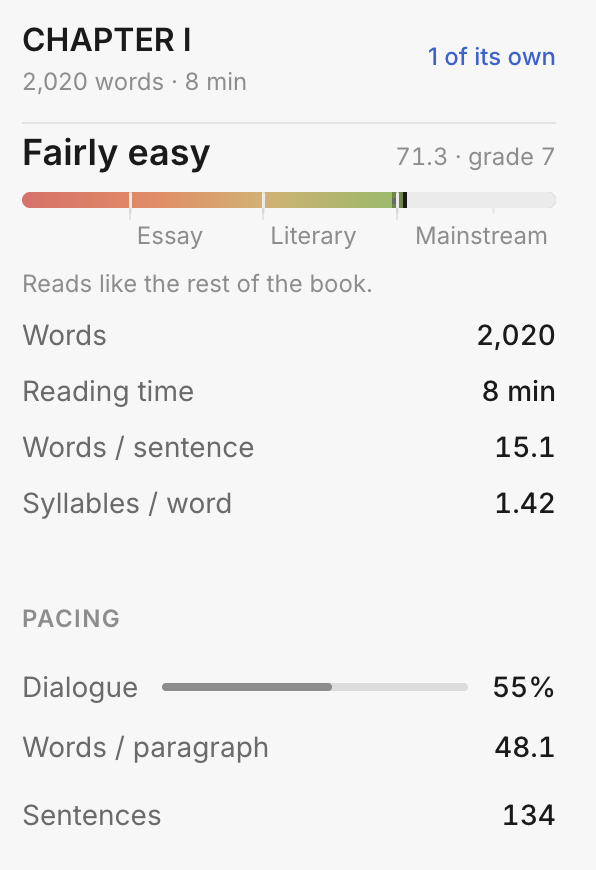
The gauge
A Flesch reading-ease score, with three bands marked:
| Band | Score | Typical of |
|---|---|---|
| Essay | around 20 | Academic and literary non-fiction |
| Literary | around 45 | Literary fiction |
| Mainstream | around 70 | Commercial fiction, most non-fiction |
The bands are reference points, not targets. A dense literary novel sitting at 30 is doing what it means to.
What is measured
Words, reading time, words per sentence, syllables per word. Under Pacing: the share of characters inside quotation marks (dialogue), words per paragraph, and sentence count.
Highlights
Switch on Highlight in the manuscript and the categories you have enabled are marked in the text itself:
| Category | Flagged when |
|---|---|
| Very hard sentences | Five separate readability formulas agree it is above about grade 14 |
| Hard sentences | The same five agree it is above about grade 10 |
| Complex words | Bureaucratic register with a plain equivalent (utilize, ascertain), offered alongside |
| Adverbs | Usually a sign a stronger verb exists |
| Passive voice | Names no one doing the action |
| Filler | Intensifiers and hedges the sentence is stronger without (very, rather, kind of) |
| Repetition | The same word three times within fifty words |
A sentence is flagged only if it is at least 14 words long and all five formulas agree. A short sentence is never called hard, however dense — the formulas are unreliable at that length, and a panel that flags “He ran.” teaches you to ignore it.
Consistency
Finds where the book does the same thing two ways.
The panel opens on what it is measured against — Itself, or one of the guides written for the book’s language — and, against itself, by saying what it is not: nothing is called wrong here; this is only what the book does two ways. Burned and burnt are both correct — a book that uses each of them fifty times is the problem.
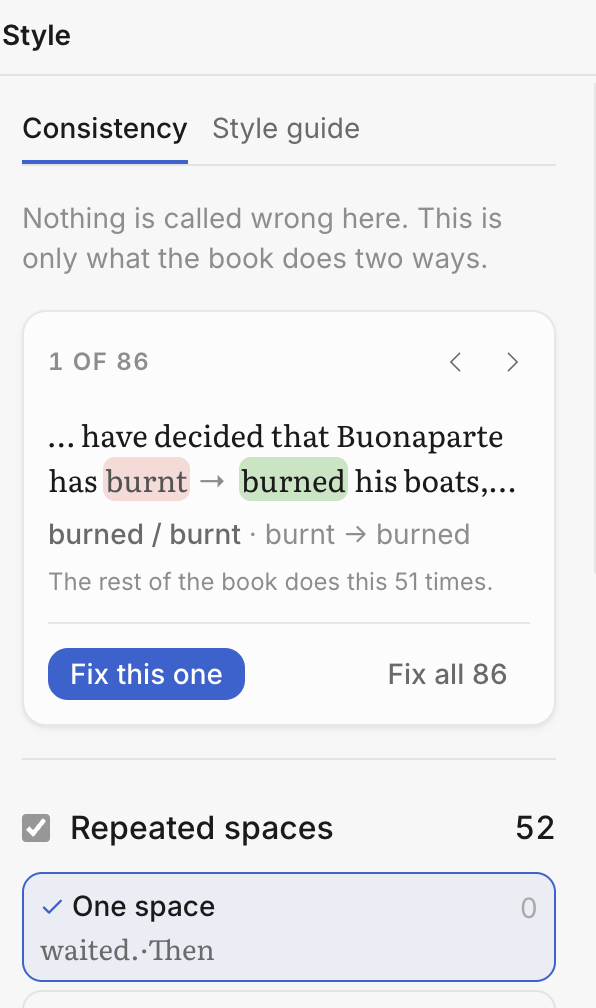
Under the headline, one card per rule with something to settle: its name, how many places would change, and what they become. Typical findings: spelling variants (analyze / analyse), the serial comma present and absent, numbers under a hundred in words or in figures, repeated spaces, inconsistent dashes, a quotation opened and never closed.
Open a card and it shows the two habits with how often the book does each, then walks that rule’s occurrences one at a time: the sentence, the change written into it, and Fix this one under it. A quotation is shown whole — opening mark, the words, closing mark — rather than one end at a time, and the occurrence is marked in the manuscript while the card is open. A line at the foot says where the work is: Mostly in chapter seven, 40 of 42 is a chapter pasted from elsewhere, and you can press it to go there.
A card whose rule the book does both ways about equally says so — Choose — and offers the two habits. Pick one, and the other places are offered as changes.
Fix all 42… on the card takes the whole rule, and Fix all 162… beside the headline takes
every rule at once. Both open the list before anything changes: every sentence that would, chapter
by chapter, with the change written into it, and Apply at the bottom. Untick the ones you want
left alone — or skip a whole chapter — and press the arrow beside a change to go and look at it in
the manuscript. It is one edit, and ⌘Z takes all of it back; the history calls it Fixed 162
style points.
Ignore sets a card aside for this sitting. Already consistent at the foot lists the rules the book keeps to one habit already, with that habit named.
Looking before deciding
The eye beside each habit walks every occurrence of it in the book, the ones that already conform included — every serial comma, every burnt. Nothing is offered on a stop that needs no change. Press the eye again to stop.
Your decisions travel with the book
The habit you settle on, and what the book is measured against, are saved in the book itself. They
are the same on your other devices and ⌘Z takes them back like any edit. Which cards you ignore
is not saved: that is a way of looking, not a decision about the manuscript.
Style guide
Pick a guide instead of Itself to check against a named manual rather than the book’s own habits. Each card then says which guide asks for the change.
| Language | Guide |
|---|---|
| English | Chicago Manual of Style (18th edition), New Hart’s Rules (2nd edition) |
| French | Lexique des règles typographiques en usage à l’Imprimerie nationale (2002) |
Use Itself to make the book agree with itself, and a guide when a publisher has asked for one.
Quotation marks
At the foot of the panel, on either tab.
Converts typewriter marks to typeset ones across the whole book. It sits with the other typographic decisions rather than among them: it is not a habit the book has two of, but one change the whole book takes at once.
| Typed | Becomes |
|---|---|
' |
’ — apostrophe or single quote |
" |
“ “ — opening and closing double quotes |
-- or --- |
— an em dash; between two numbers, -- becomes an en dash (1914–1918) |
... |
… — an ellipsis |
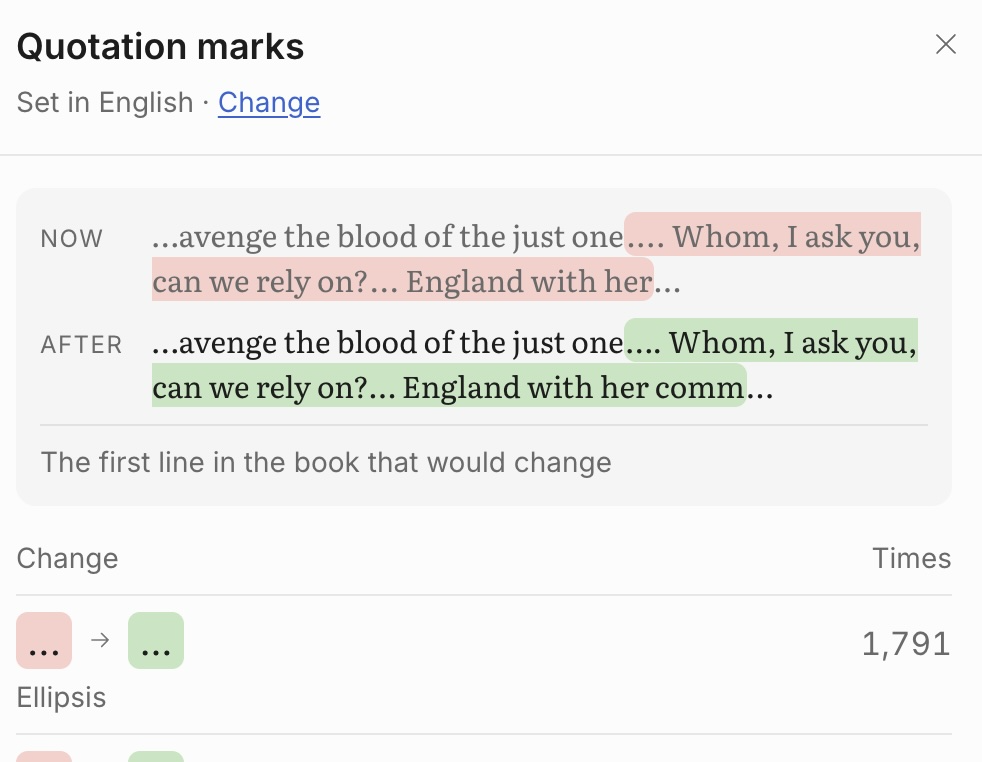
The dialog lists what it found and what it will change, grouped by kind, before you convert anything.
An apostrophe and a closing single quote are the same character, which is why a straight ' cannot
be converted correctly by rule alone in every case. The dialog shows the first line in the book that
would change, before and after, so you can check what it decided — and the conversion is one edit,
so ⌘Z takes the whole of it back.
Version history
Top right: click the save indicator.
Every save on this device, grouped by day — today, yesterday, then dates. It opens from the save indicator because it answers the same question one step further on: the indicator says the work is safe, and this is where you see it.
Most rows are just a record of what happened: the edit is already in the book, so there is nothing to bring back and no button.
A row does carry Re-apply when it holds a version that was set aside rather than committed. That happens when the same block was edited on two devices: the remote version wins, and yours is preserved here instead of being lost. The count on the menu item — History · 2 kept — is how many are waiting, and a dot on the save indicator says there are some before you open it.